Bracket voting maker: what you get
Create a head-to-head ballot that each person completes before seeing the crowd result. The reveal combines a personal champion with group advance rates, while browser-level duplicate limits stay clearly labeled as casual protection.
- Complete private ballots
- Submit-before-reveal
- Crowd champion share
- Advance-rate analysis
- Casual duplicate protection
Bracket voting maker: why head-to-head polls feel different
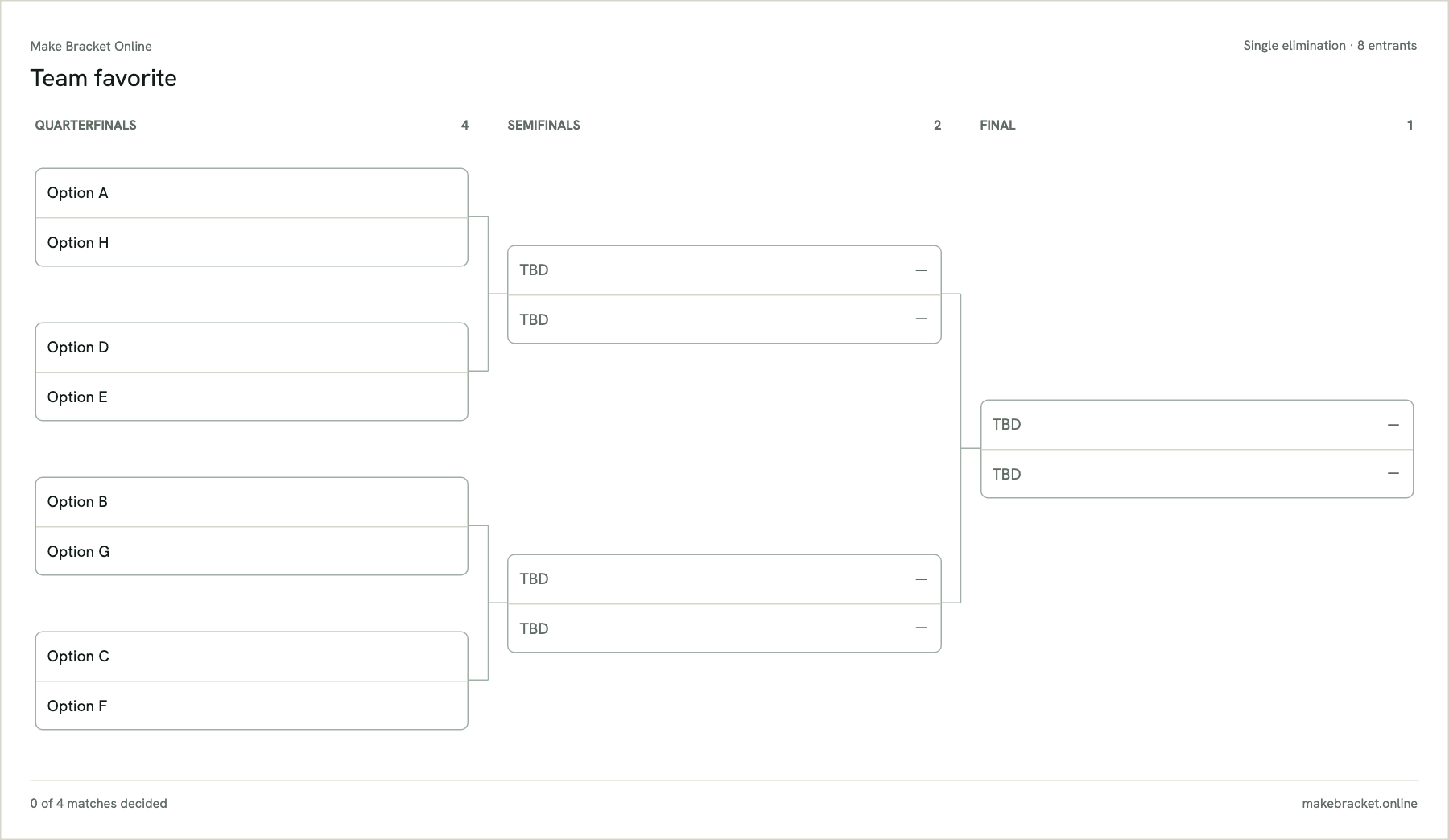
A normal poll asks one isolated question. A voting bracket turns a large set into a sequence of direct comparisons, so participants can make progress without ranking every option at once. The final winner is the option each person advanced through their own complete path.
The tool hides crowd results until a ballot is submitted. That reduces anchoring: early voters do not set a visible favorite that later voters simply follow.
How bracket voting calculates a crowd champion
Different voters can create different later-round matchups. For that reason, the site does not combine fixed A/B positions into a fake majority bracket. The crowd champion is the entrant with the most final-champion votes, and advance rates show how often each entrant survived each round.
After submission, voters see their agreement with the current node-level consensus and can discover whether their champion was common or a rare pick. This is the social payoff worth sharing.
Bracket voting links, host controls and duplicate limits
The creator receives a private management link for opening or closing the poll and viewing the aggregate. Participants use a separate public link. A browser token limits accidental repeat submissions without requiring accounts.
This is appropriate for friends, classrooms, communities and internal team decisions. It is not a verified election system: clearing cookies or changing browsers can bypass casual duplicate protection, and identity is not proven.
Share a bracket poll people want to complete
The reveal pairs a personal champion card with the crowd distribution. That gives the voter both an identity result and a comparison to the group, rather than ending with a generic success message.
Use concise, mutually comparable entrants. For policy choices or high-stakes decisions, add context outside the bracket and use a voting system designed for identity, eligibility and auditability.
Bracket voting ballot size reference
A complete single-elimination ballot contains N-1 head-to-head choices. Larger fields create more expressive paths, but every extra round also increases abandonment risk.
| Entrants | Rounds | Choices per ballot | Typical use |
|---|---|---|---|
| 4 | 2 | 3 | Quick group choice |
| 8 | 3 | 7 | Class, team or friend group |
| 16 | 4 | 15 | Community ranking |
| 32 | 5 | 31 | High-engagement audience |
Bracket voting question design checklist
People finish a ballot when each comparison feels understandable and the final result promises a meaningful social reveal.
- 1
Comparable entrants. Keep every option at the same level, such as movies versus movies, rather than mixing categories.
- 2
Readable labels. Use names people recognize without needing a separate explanation for every matchup.
- 3
Reveal timing. Hide aggregate results until submission so early favorites do not anchor later voters.
- 4
Ballot length. Eight or sixteen entrants usually balance variety with completion time for casual groups.
- 5
Risk boundary. Browser duplicate protection is not identity verification; use formal voting software for consequential elections.
Bracket voting maker frequently asked questions
Can voters see results before voting?
No in the voting interface. The crowd distribution is revealed after a complete ballot is submitted.
How is the crowd champion calculated?
It is the entrant selected as final champion on the largest number of complete ballots.
Is it one person, one vote?
It uses browser-based casual duplicate protection. It does not verify real-world identity and should not be used for formal elections.
Can I stop new votes?
Yes. The private host page can close the poll while keeping its public result available.