Tournament bracket maker: what you get
Build a 2-to-64 team tournament bracket, choose single elimination, double elimination or round robin, and create a live organizer space when scores need to be recorded after the draw is shared.
- 2 to 64 entrants
- Three tournament formats
- Automatic byes and routing
- Private host and public links
- PNG, PDF and print output
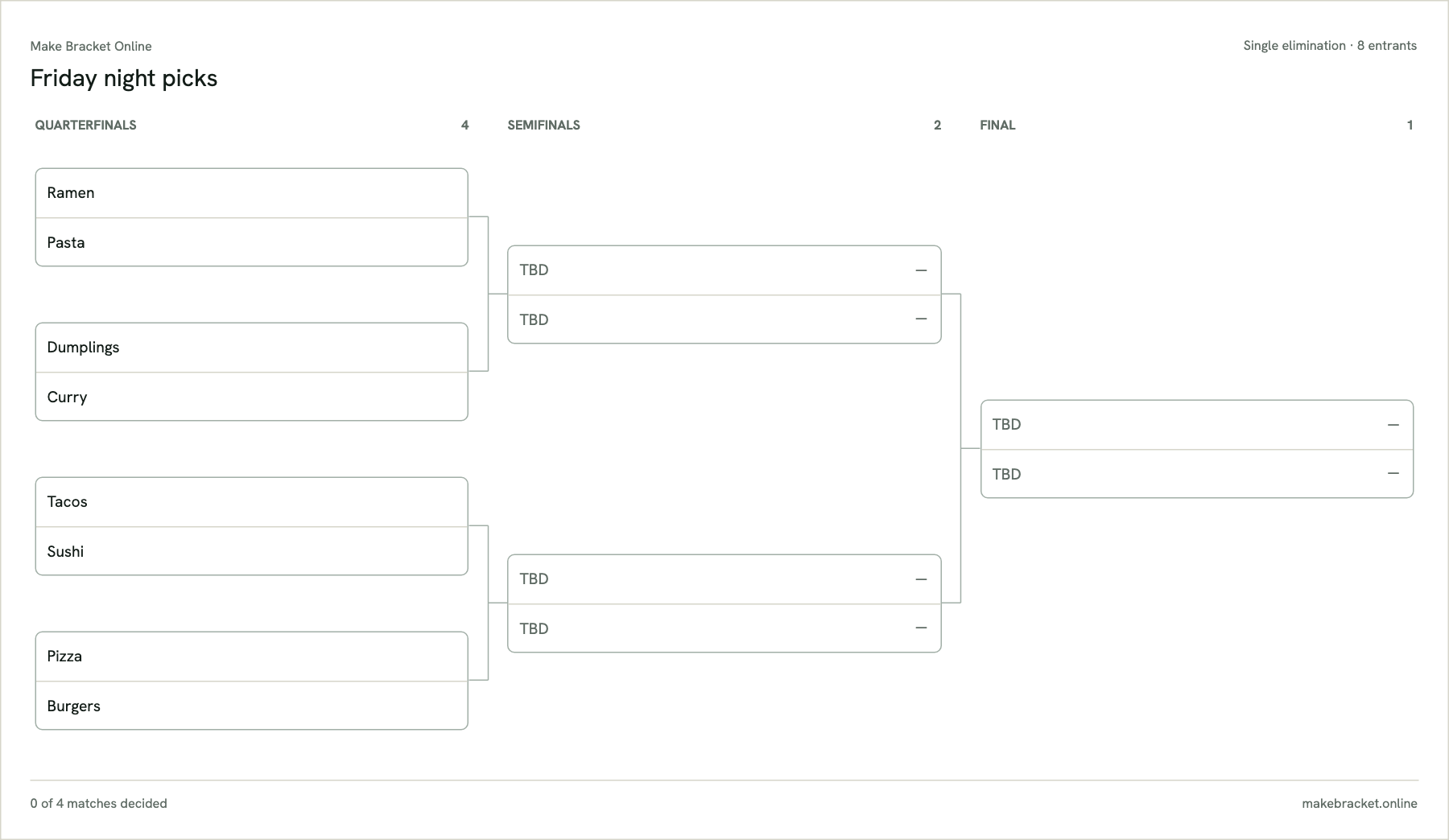
Tournament bracket maker: choose the constraint before the layout
A tournament bracket is a set of dependencies, not a decorative tree. Decide first whether your event needs the fastest champion, a second chance after one loss, or a schedule where every entrant plays several times. The format determines the match count, rest time and what a fair result means.
This maker turns that choice into a connected event record. Names, byes and later matchups remain linked, so correcting an early result clears only the impossible path rather than forcing an organizer to redraw the whole event.
- Single elimination: N-1 real matches
- Double elimination: usually 2N-2 matches
- Round robin: N(N-1)/2 matches per single cycle
How to make a tournament bracket that players can trust
Start with one unique entrant per line and publish the seed or draw method before the first match. For uneven knockout fields, automatic byes fill the unused power-of-two slots. They are visible advances, not pretend wins.
Use the private host link for score entry and the public link for participants. This small separation protects the record: spectators can follow a live tournament without being able to overwrite a result or disturb the host's event controls.
Tournament bracket formats for common event problems
Use single elimination for a one-day final, a short playoff or any event where venue time is scarce. Use double elimination for games where one early loss should not end a participant's day. Use round robin for leagues and qualifying groups, then move the leading teams into a separate playoff bracket.
The useful distinction is operational, not stylistic. A lower bracket gives a direct opponent a second life; a round-robin table compares several completed fixtures. Treating them as interchangeable is how schedules become misleading.
- Need a decisive final quickly: single elimination
- Need every entrant to survive one loss: double elimination
- Need a transparent table before finals: round robin
Tournament bracket format reference
Match volume determines whether a format fits your courts, tables or broadcast window. N means real entrants, not the larger opening slot count.
| Format | Match count | Minimum matches per entrant | Best use |
|---|---|---|---|
| Single elimination | N - 1 | 1 | Short knockout or playoff |
| Double elimination | Usually 2N - 2 | 2 | Second-chance event |
| Single round robin | N(N - 1) / 2 | N - 1 | League or qualifying phase |
Tournament organizer checklist
Make the public structure match the rules and venue plan before you send an invite.
- 1
Field. Use one unique name per entrant and decide whether the order represents seeds or a random draw.
- 2
Format. Choose a format from match capacity and fairness, not the shape that looks most familiar.
- 3
Byes. For uneven knockout fields, state which seeds receive automatic advances.
- 4
Result authority. Keep the host link private and share the public record with players and spectators.
- 5
Final artifact. Export PNG for chat, PDF for a venue backup and the public link for live updates.
Tournament bracket maker frequently asked questions
How many teams can this tournament bracket maker handle?
Add from 2 to 64 entrants. Knockout formats create the next valid bracket size and show automatic byes where needed.
Which tournament format should I choose?
Use single elimination for speed, double elimination for a second life after one loss, and round robin when every entrant needs several scheduled opponents.
Can players see a live tournament bracket?
Yes. Create the tournament space, retain the private host link for changes and share the read-only public link with participants.
Can I print the tournament bracket?
Yes. Download PNG or PDF output, or use the browser print dialog after the connected bracket is ready.