Playoff bracket maker: what you get
Use this playoff bracket maker after league play, a group stage or a regular season. Add the qualifiers in seed order, choose a knockout format and share one public path to the final.
- 2 to 64 playoff teams
- Seeded first round
- Automatic byes
- Live winner advancement
- Share and printable export
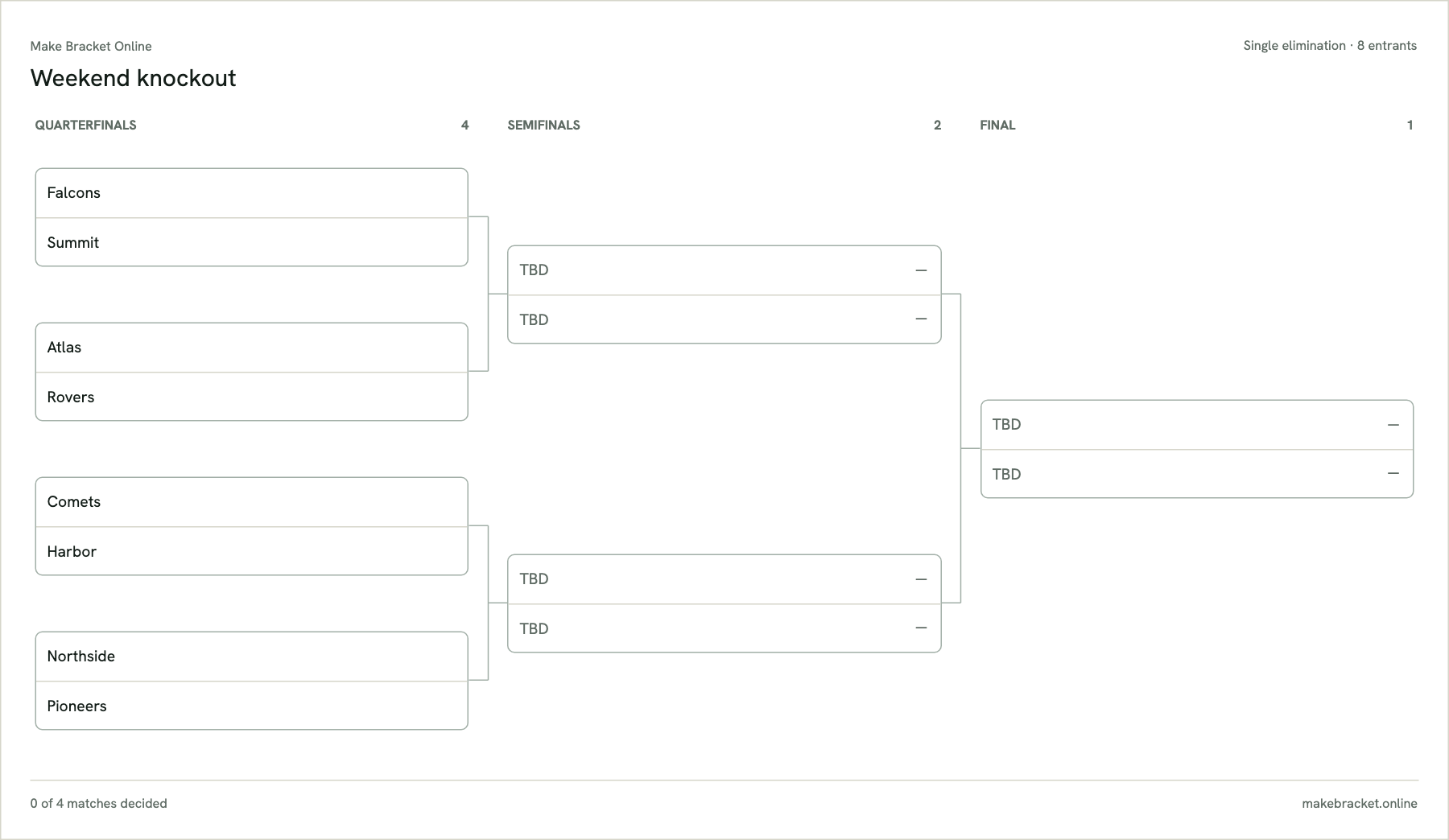
Playoff bracket maker: turn qualifiers into a seeded knockout
A playoff bracket begins after qualification, not after a random draw. Enter the teams in published seed order and the maker maps them to a balanced knockout shape. If the field is not a power of two, the empty positions become visible first-round byes rather than unrecorded exceptions.
That distinction matters for a six-team playoff. The top seeds should advance because the rules awarded them a bye, while the remaining teams play an opening round. The bracket makes that structure readable for both teams and spectators.
- 6 teams: 8 slots, 2 byes and 5 matches
- 8 teams: 7 matches
- 10 teams: 16 slots, 6 byes and 9 matches
How to seed a playoff bracket
Use regular-season rank, group-stage position or another published qualification rule to order the field. Avoid reseeding a later round unless that rule is announced up front; a fixed path is easier to follow and review after a result changes.
This tool preserves the opening order and advances winners into the correct later match. If an organizer corrects a source result, dependent paths clear so an eliminated team cannot remain in a semifinal by accident.
When a playoff bracket needs double elimination instead
Most playoffs are single elimination because the field is already filtered and venue time is limited. Choose double elimination only when the finals phase intentionally gives every qualifier a second chance and the schedule can absorb roughly twice as many matches.
For league standings plus a playoff handoff in one workspace, use the league schedule tool. It calculates the table from completed fixtures first, then sends the current top field into a connected knockout bracket.
- Single elimination: the usual postseason choice
- Double elimination: a longer second-chance final stage
- League standings: calculate qualification before seeding
Playoff bracket size reference
A single-elimination playoff has one fewer real match than qualifiers. Opening slots only determine how many byes are needed.
| Qualifiers | Opening slots | Byes | Matches | Rounds |
|---|---|---|---|---|
| 4 | 4 | 0 | 3 | 2 |
| 6 | 8 | 2 | 5 | 3 |
| 8 | 8 | 0 | 7 | 3 |
| 10 | 16 | 6 | 9 | 4 |
Playoff setup checklist
Publish these decisions before the postseason begins so a bracket result is auditable.
- 1
Qualification. State which completed record or group position qualifies each seed.
- 2
Seed order. Enter teams in the official order and make any tiebreak rule available separately.
- 3
Byes. Show automatic first-round advances for an uneven playoff field.
- 4
Reseeding. Use a fixed path unless the rules expressly require reseeding after each round.
- 5
Public record. Share the read-only bracket while the organizer retains the host link for source corrections.
Playoff bracket maker frequently asked questions
Can I make a 6-team playoff bracket?
Yes. A six-team field uses eight opening slots, so two top seeds receive automatic first-round byes and five real matches decide the champion.
Can I seed the playoff bracket?
Yes. Place qualifiers in seed order before the event starts. The opening positions and required byes are generated from that order.
Can I use this for NBA, NFL or other fan playoffs?
You can enter any field for a fan prediction or local event. This is an independent bracket tool, not an official league fixture or live data feed.
Can I print a playoff bracket?
Yes. Download a PNG or PDF, or use the browser print dialog after teams and results are ready.