League schedule and standings generator: what you get
Create a fair round-robin schedule, record scores in one place, and keep the live table readable. When league play ends, send the top teams into a playoff bracket without rebuilding the field.
- Single or home-and-away fixtures
- Live score entry
- Points and goal difference
- Visible table tiebreaks
- Top-team playoff bracket
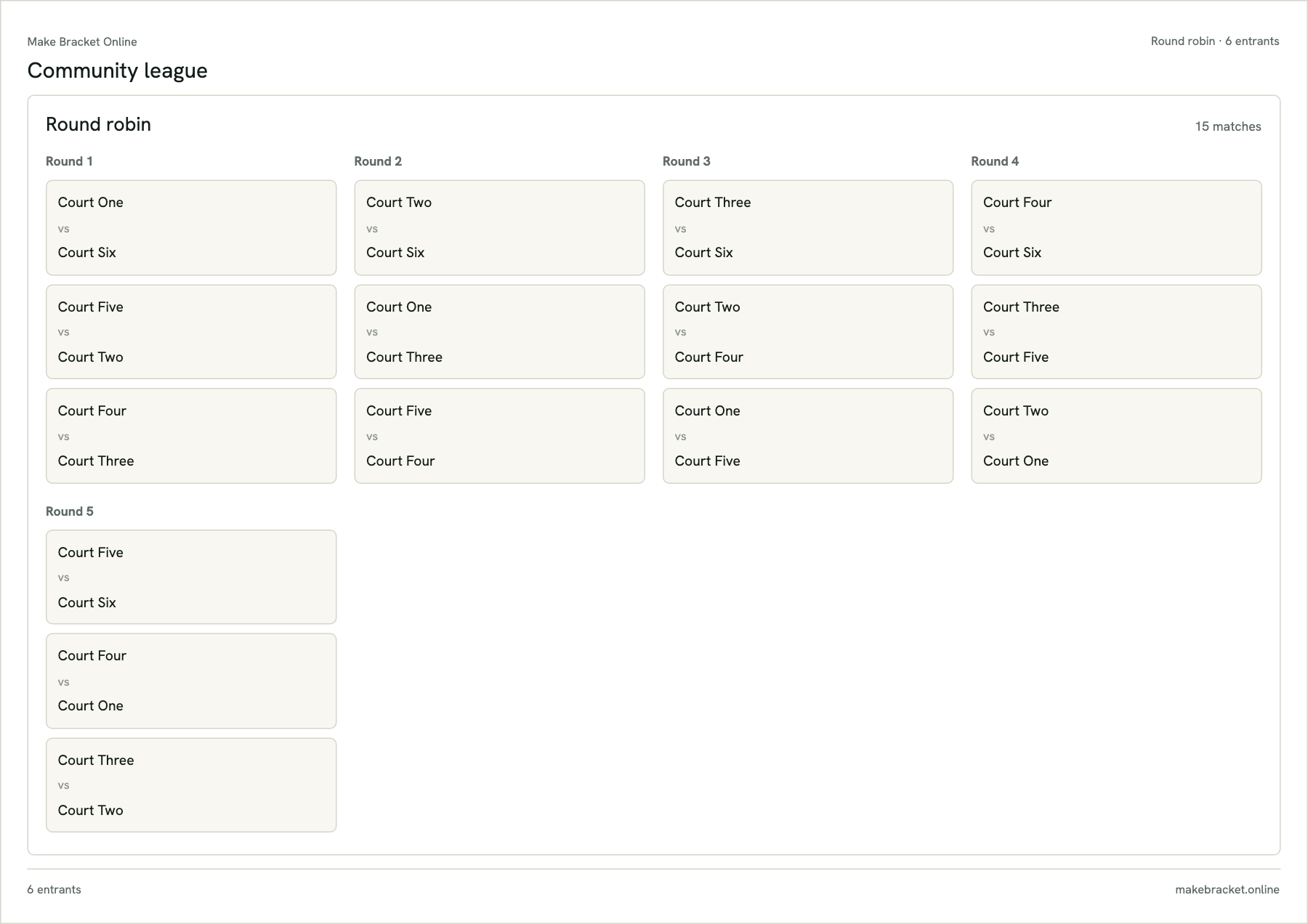
League schedule and standings generator: the organiser record
A league schedule is more than a list of pairings. Teams need to know when they play, how many fixtures count, and why a table changes after each score. This generator creates a round-robin schedule, accepts results and calculates the record from completed matches only.
The standings stay useful because every column has a job: played confirms whether teams have completed the same amount of work; wins, draws and losses show the path; goals for and against produce goal difference; points determines the initial rank.
- Single round robin: each pair meets once
- Home and away: each pair meets twice with reversed home team
- Odd fields rotate one bye per round instead of silently omitting a team
How league standings are calculated
The default table awards three points for a win and one for a draw. Teams level on points are sorted by goal difference, then goals scored. A final alphabetical fallback prevents an unstable display, but it is not a substitute for a competition's official head-to-head or disciplinary tiebreak rule.
That distinction is deliberate. A good public table says what it knows and what it does not know. For a sanctioned league, record the governing tiebreak in the rules before fixtures start; do not retrofit it when the last score arrives.
- Played matches are the only ones counted
- Blank score fields do not become a draw
- A result can be corrected and the table recalculates immediately
League schedule generator with a playoff handoff
Many community leagues need both a table and a final event. Select the number of teams that advance, then the current top teams appear in a connected playoff bracket. The field follows the table, so an updated result can change the cutoff before a final seed is locked.
This is intentionally a handoff, not a false promise of an official season simulator. The tool does not infer future fixtures, injuries or league-specific tiebreakers. It gives a small organiser a transparent record and a clean way to begin the decisive stage.
- Top 2: one final
- Top 4: semifinals and final
- Top 8: quarterfinals, semifinals and final
Single round robin versus home and away
Use a single round robin when venue time is limited and every pair only needs one meeting. Use home and away when the venue, surface or host advantage must balance out over the season. Doubling the schedule doubles each pair of fixtures, so it should be chosen before dates are assigned.
For large fields, a full round robin becomes expensive quickly. If the number of fixtures is more than the league can actually host, split the field into groups and use a qualification stage instead of publishing an unrealistic complete schedule.
- 6 teams, single round robin: 15 fixtures
- 6 teams, home and away: 30 fixtures
- 10 teams, single round robin: 45 fixtures
- 10 teams, home and away: 90 fixtures
League schedule match count reference
A single round robin has N(N - 1) / 2 fixtures. Home and away doubles the number, which is why fixture volume should drive the format decision.
| Teams | Single round robin | Home and away | Matches per team |
|---|---|---|---|
| 4 | 6 | 12 | 3 or 6 |
| 6 | 15 | 30 | 5 or 10 |
| 8 | 28 | 56 | 7 or 14 |
| 10 | 45 | 90 | 9 or 18 |
League schedule checklist
Set the operational rules before you ask teams to rely on the table.
- 1
Field. Use one unique name per team. An odd field has a visible rotating bye.
- 2
Format. Choose single or home-and-away before assigning dates; the fixture count is different.
- 3
Scoring. Publish the points rule and whether forfeits, penalties or walkovers have a special result.
- 4
Tiebreak. Confirm whether goal difference is correct for your league or whether head-to-head overrides it.
- 5
Cutoff. State how many teams advance to playoffs and when the table becomes final.
- 6
Corrections. Correct a source score first. The standings and playoff field will recalculate from that record.
League schedule and standings generator FAQs
Can I create a league schedule with five teams?
Yes. One team has a bye in each round, rotating so every team sits out once in a single round robin.
Does the table handle draws?
Yes. A draw gives both teams one point. The tool also tracks wins, losses, goals for, goals against and goal difference.
Can I make a home and away schedule?
Yes. Select home and away to repeat every pairing with the home team reversed.
Can I use this as an official standings system?
Use it for transparent local record-keeping. Confirm any sport-specific tiebreak, disciplinary or forfeiture rule with the competition organiser before treating it as official.