Group stage to knockout generator: what you get
Split a field into balanced groups, record each result, and let the table determine who reaches the knockout bracket. The same workspace keeps the qualifying rule visible from the first fixture to the final.
- Balanced seeded groups
- Round-robin fixtures
- Live points and goal difference
- Visible tiebreak order
- Knockout qualifiers
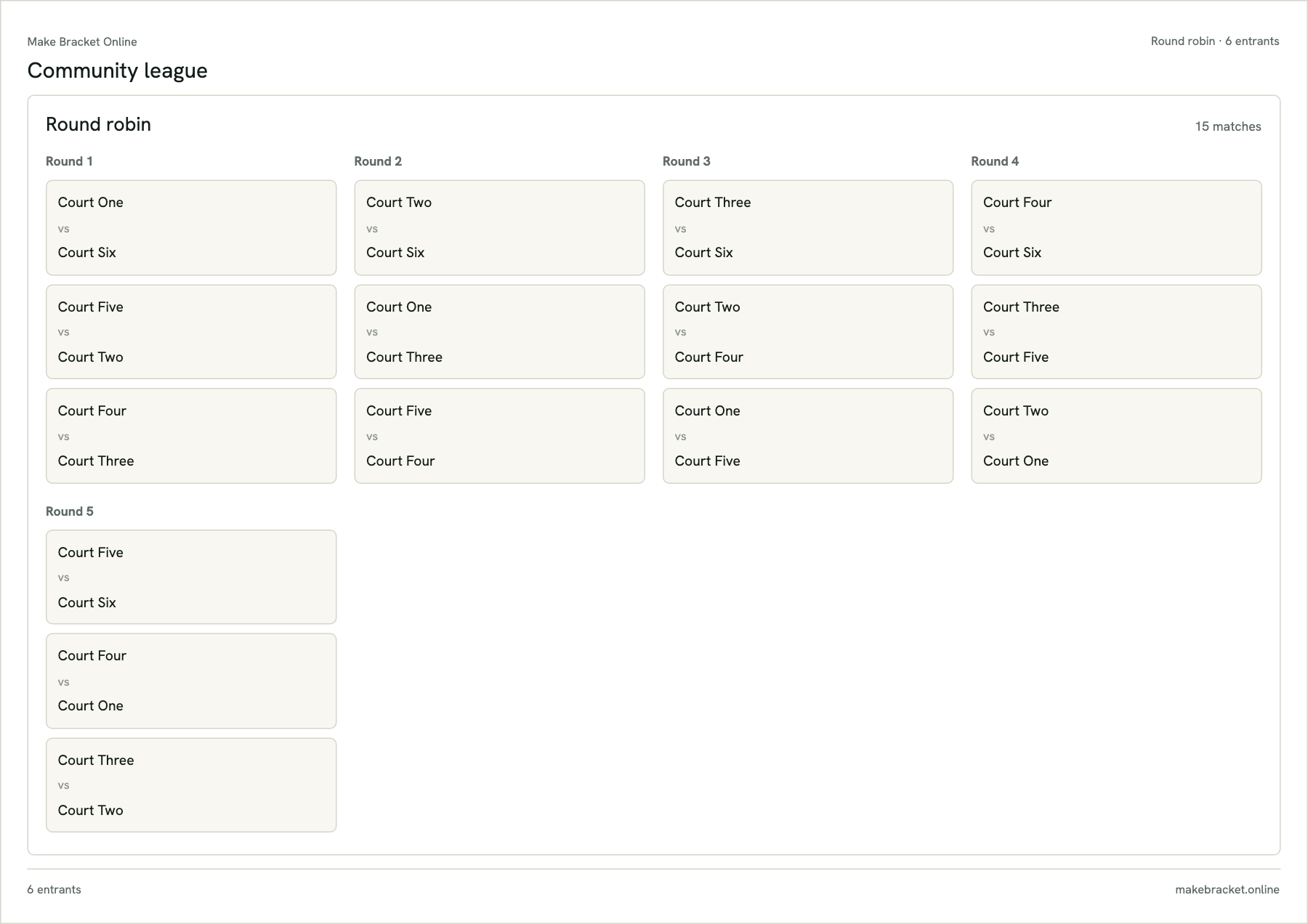
Group stage to knockout generator: what it solves
A group stage answers a question a normal bracket cannot: who earned a place in the final stage after playing more than once? Enter a team list, choose equal groups, then record scores as fixtures finish. The table updates points, goal difference and goals scored before it selects the qualifying teams.
The knockout bracket is created from the table rather than a copied list. That matters when a late result changes second place: the finals field is recalculated visibly, so the organiser does not have to manually repair an outdated draw.
- Three points for a win, one for a draw
- Ties: points, goal difference, goals scored, then name
- Top two from each group advance in the default group-stage setup
How group stage standings feed the knockout bracket
The tool uses a round-robin fixture list inside each group. Every completed score updates played, wins, draws, losses, goals for, goals against and points. Incomplete fixtures stay out of the table rather than being treated as a zero-zero draw.
When there are two qualifiers per group, group winners are paired with a neighbouring group runner-up. This keeps teams from the same group apart in the opening knockout round whenever the field has a standard even group layout.
- 4 groups of 4 teams: 24 group fixtures, then an 8-team knockout
- 2 groups of 4 teams: 12 group fixtures, then a 4-team knockout
- Use equal group sizes to keep the minimum number of fixtures fair
When a group stage is better than double elimination
Use group play when every team needs a predictable number of games and the competition should reward consistency. Use double elimination when the event is short and the point is to survive a first loss. The formats are not substitutes: group tables compare records across several fixtures, while a lower bracket gives a second chance in a direct elimination path.
A small tournament can use both. Let teams qualify through groups, then use the knockout stage for the decisive final. That creates an understandable rule for casual players, spectators and organisers without hiding a judgment call inside a spreadsheet.
- Choose group stage for leagues, pools and qualifying rounds
- Choose double elimination for shorter events with a second chance
- Choose single elimination when time and venue capacity are the primary constraint
How to handle tiebreakers before the first match
Publish the points and tiebreak order before the draw. This generator makes its default order visible, but a sanctioned competition may use head-to-head results, disciplinary points or a drawing of lots instead. In that situation, use the table as the record and state the governing rule alongside it.
Do not change the tiebreaker after teams begin playing. A clear rule gives the same information to the team that advances and the team that misses out, which is more valuable than an attractive but unexplained final bracket.
Group stage to knockout format reference
Fixture count grows inside each group, while the final stage remains a simple knockout. Plan both parts before confirming your venue time.
| Format | Group fixtures | Qualifiers | Knockout matches |
|---|---|---|---|
| 2 groups of 4 | 12 | 4 | 3 |
| 4 groups of 4 | 24 | 8 | 7 |
| 4 groups of 3 | 12 | 8 | 7 |
| 8 groups of 4 | 48 | 16 | 15 |
Group stage organiser checklist
Make the qualification rule easy to verify while there is still time to correct a fixture.
- 1
Group allocation. Use a seeded or published draw. The snake allocation keeps sequential seeds balanced across equal groups.
- 2
Fixture rule. State whether every team plays once or home and away, and leave byes visible for odd groups.
- 3
Points rule. Confirm the value of a win and draw before the first score is recorded.
- 4
Tiebreak order. Use the visible default only when it matches your event rules; otherwise publish the override.
- 5
Qualification. Name how many teams advance and whether group winners must avoid their own runners-up in round one.
- 6
Finals handoff. Check the qualified field before starting the knockout bracket so no manual list is carried forward.
Group stage to knockout generator FAQs
Can I create groups with an odd number of teams?
Yes. The round-robin schedule rotates a bye so each team sits out once. The table only counts completed fixtures.
How are group stage standings calculated?
A win is worth three points and a draw one. Tied teams are ordered by points, goal difference, goals scored, then team name as a visible fallback.
Can I send more or fewer than two teams through?
The group-stage workflow defaults to the top two. Use equal groups and a power-of-two finals field when you need a different qualification rule.
Does the tool claim to run an official competition?
No. It is an organiser tool. Check your sport's official regulations before using its tiebreak or qualification rules in a sanctioned event.