Double elimination bracket maker: what you get
Use double elimination when every entrant should survive one loss. The tool builds winners and lower brackets together, routes each loser automatically, and supports the usual 2N-2 match structure.
- Winners and lower brackets
- Automatic loser routing
- Scores and match status
- Private host link
- Public read-only bracket
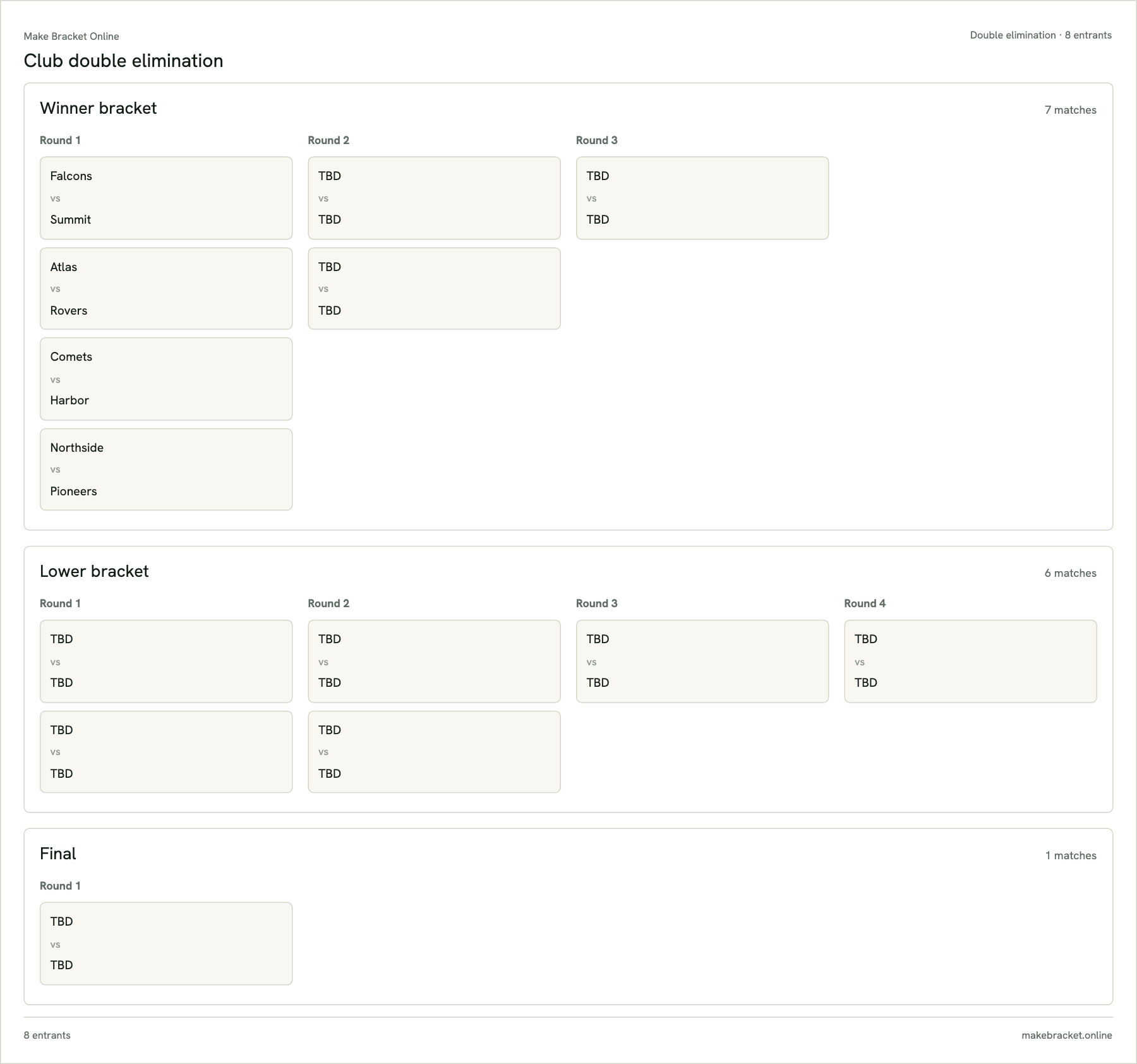
Double elimination bracket maker: two losses, one winner
In double elimination, an entrant moves to the lower bracket after its first loss and leaves the tournament after its second. The workbench generates both paths together and uses the tournament engine to route each result. You do not need to decide manually which lower-bracket match receives a loser.
A standard field needs roughly twice as many matches as single elimination: 2N-2 with a single grand final, or 2N-1 when the rules require a reset if the lower-bracket finalist wins the first final.
How winners and lower brackets connect
The winners bracket proceeds like a knockout bracket. Lower-bracket rounds alternate between receiving new losers and eliminating entrants already in that path. The final group brings the surviving entrant from each side together.
State the grand-final rule before play begins. This maker uses a single grand final by default for a predictable schedule. If your league requires a bracket reset, budget one additional match and communicate that possibility to players and the venue.
Double elimination bracket byes and match counts
Fields such as 5, 6 or 10 expand to a balanced power-of-two bracket. First-round byes are distributed by seed, and the tournament engine carries those automatic advances through both bracket structures without creating fake scored matches.
Random draws are useful for casual events; seeded draws are better when prior ranking should reward stronger entrants. The entrant order remains editable until the space is created.
When a double elimination bracket is the right choice
Double elimination fits esports, fighting games, table games and club tournaments where one bad matchup should not end the day. It costs more time and is harder for spectators to scan than single elimination, but it gives every entrant at least two competitive opportunities.
Share the public page for spectators and keep the capability-based management link private. Score changes update the connected bracket; the public page cannot submit edits.
Double elimination match count reference
With one grand final, a standard double elimination event usually has 2N-2 matches. A bracket-reset rule adds one possible final because the winners-bracket finalist has not yet lost twice.
| Entrants | Winners path | Usual total | Maximum with reset |
|---|---|---|---|
| 4 | 3 | 6 | 7 |
| 6 | 5 | 10 | 11 |
| 8 | 7 | 14 | 15 |
| 10 | 9 | 18 | 19 |
| 16 | 15 | 30 | 31 |
Double elimination organizer checklist
The format only feels fair when entrants and staff understand the lower path before the first result is entered.
- 1
Grand-final rule. State whether the event ends after one final or resets when the lower-bracket finalist wins.
- 2
Schedule capacity. Budget roughly twice the matches of single elimination plus turnaround time between lower-bracket rounds.
- 3
Lower-bracket labels. Use round numbers consistently so staff can find where each winners-bracket loser lands.
- 4
Player rest. Avoid sending a lower-bracket winner immediately into another match when venue time allows a buffer.
- 5
Host access. Only the organizer needs the capability link; public viewers should receive the read-only bracket.
Double elimination bracket maker frequently asked questions
How many matches are in double elimination?
Usually 2N-2 with one grand final. A true reset final can add one more match, making the maximum 2N-1.
What happens after the first loss?
The entrant is routed into the correct lower-bracket match. A second loss eliminates them.
Can I use 6 or 10 entrants?
Yes. The field receives balanced byes before winners and losers routing begins.
Can spectators edit results?
No. The public link is read-only. Only the private host capability link can update a match.